
RESEARCH & DEVELOPMENT: JOHN HALL& BRANDEN DUPONT
NYC Youth Crime in Context: Arrest & Recidivism
Key Data Insights
- In 2024, the youth share of citywide felony and violent felony arrests was the same as it was in 2018.
- A small proportion of youth felony arrests (~5%) are for the most serious violent felony crimes, where 16-17s have seen an uptick as a share of citywide crime, mostly in the past year (2024-2025). The small proportion of 13–15-year-olds has increased steadily in this category in recent years.
- Youth recidivism rates for all felony, violent, and serious violent offenses are stable or decreasing. Most youth are reoffending at or below 2018 levels.
Arrests by Age: Felony, Violent, and Serious Violent Crimes
Adults, especially those aged 35–44, have driven the expansion in felony arrests. Juveniles accounted for 6.5% of felony arrests in 2024, down slightly from 6.8% in 2018. Adults aged 35–44 increased from 18.7% to 23.5% of all felony arrests, the largest gain of any group. Young adults (18–24) lost share despite modest growth in counts. In short, adults, not teens, have disproportionately contributed to the post‑2018 rise in felony arrests.
The same pattern appears in arrests for VFOs. The under-18 share declined from 11.9% in 2018 to 10.9% in 2024, reaching a low in 2021 before edging up to 12.5% mid-year in 2025. Although under-18 counts increased from 3,185 to 4,297 (+34.9%), total VFO arrests rose faster (26,791 to 39,364, +46.9%), shifting the largest share to adults aged 35–44, who reached 21.4% by 2024, up from 16.3%. Within teenage cohorts, both 16–17 and 18–19-year-olds lost share of total VFOs, while 13–15-year-olds increased in proportion from 4.7% in 2018 to 5.1% in 2024.
By contrast, the Serious VFO category shows a different pattern. Here, youth gained share while adult shares fell. Under-18 arrests rose from 9.8% in 2018 to 15.6% in 2024, and to 23.3% mid-year in 2025, marking a divergence from the broader downward trend in youth involvement.
Within this group, every juvenile subset increased in both share and total arrests, as did 18–19-year-olds. Between 2018 and 2024, arrests of 13–15-year-olds for Serious VFOs increased by 182% (44 to 124), arrests of 16–17-year-olds grew by 124% (91 to 204), and arrests of 18–19-year-olds grew by 69% (127 to 215).
Recidivism by Age: Felony, Violent, Serious Violent Felony Offenses
Youth felony recidivism rose briefly after 2018 but returned to near baseline by 2024. The under-18 rate increased from 33.3% in 2018 to 37.6% in 2020, then declined to 32.3% by 2024. The drop contrasts with a steady climb among adult age groups. Recidivism rose among those aged 30–44 and 55+, indicating that the post-2018 increase in felony reoffending was largely driven by adults rather than juveniles. Youth now reoffend at rates similar to, or below, pre-RTA levels, while adult patterns show gradual but persistent growth.
Within the youth population, trends diverged by age. 16–17‑year‑olds showed the largest improvement, with recidivism falling from 35.8% to 29.1%. 18–19-year-olds remained essentially stable, dropping slightly from 33.6% to 32.1%, while 13–15-year-olds rose from 30.5% to 36.3%. The chart below highlights a steady reduction among older teens following the implementation of RTA, while younger adolescents experienced modest increases and the adjacent young-adult group leveled off.
For VFOs, under-18 recidivism in 2024 was nearly unchanged from 2018 (31.9% vs. 30.8%). Within youth cohorts, 16–17-year-olds declined modestly, 18–19-year-olds held flat, and 13–15-year-olds rose slightly. In the narrower Serious VFO group, youth recidivism spiked before and during the pandemic but returned to its baseline by 2024 (25.4% vs. 25.0% in 2018). These data show that while overall youth felony recidivism stabilized, serious violent reoffending remains contained and has not increased compared to 2018.
Additional Context:
Youth/Young Adult Count and Share of Citywide 7 Major Arrests Since 2007
Using a different data source (NYPD Open Data) and data definitions, below are longer-term changes in arrest patterns over time since 2007.
Longer Term Rearrests
Of people who were under 18 with a felony arrest in 2018, they had a sharp and sustained reduction in rearrests over time after that year.
People Under 18 with a Felony Arrest in 2018 and Their Felony Rearrests Over time

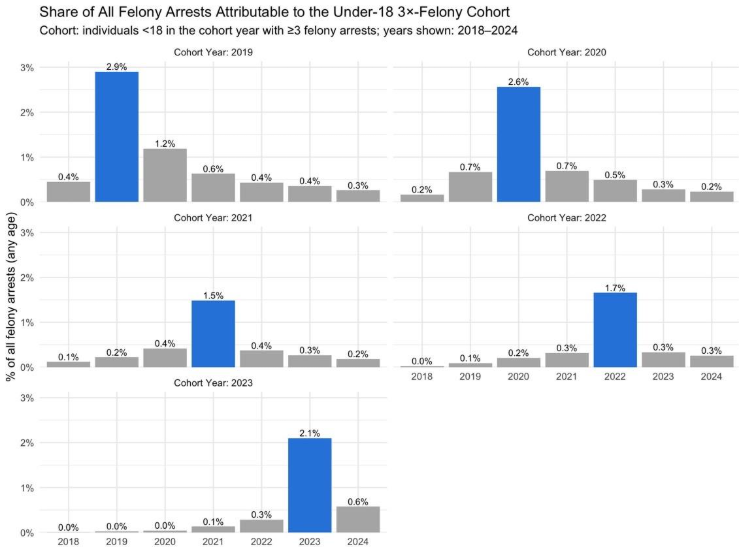
Longer Term Rearrests of People Under 18 with 3+ Felony Arrests in a Year
People who were under 18 with 3 or more felony arrests in 2021 were responsible for 1.5% of citywide felony arrests in 2021. Following the same group of people forward, the following year that group was responsible for 0.4% of citywide felony arrests, and 0.2% in 2024. Similar patterns are seen for other year cohorts.
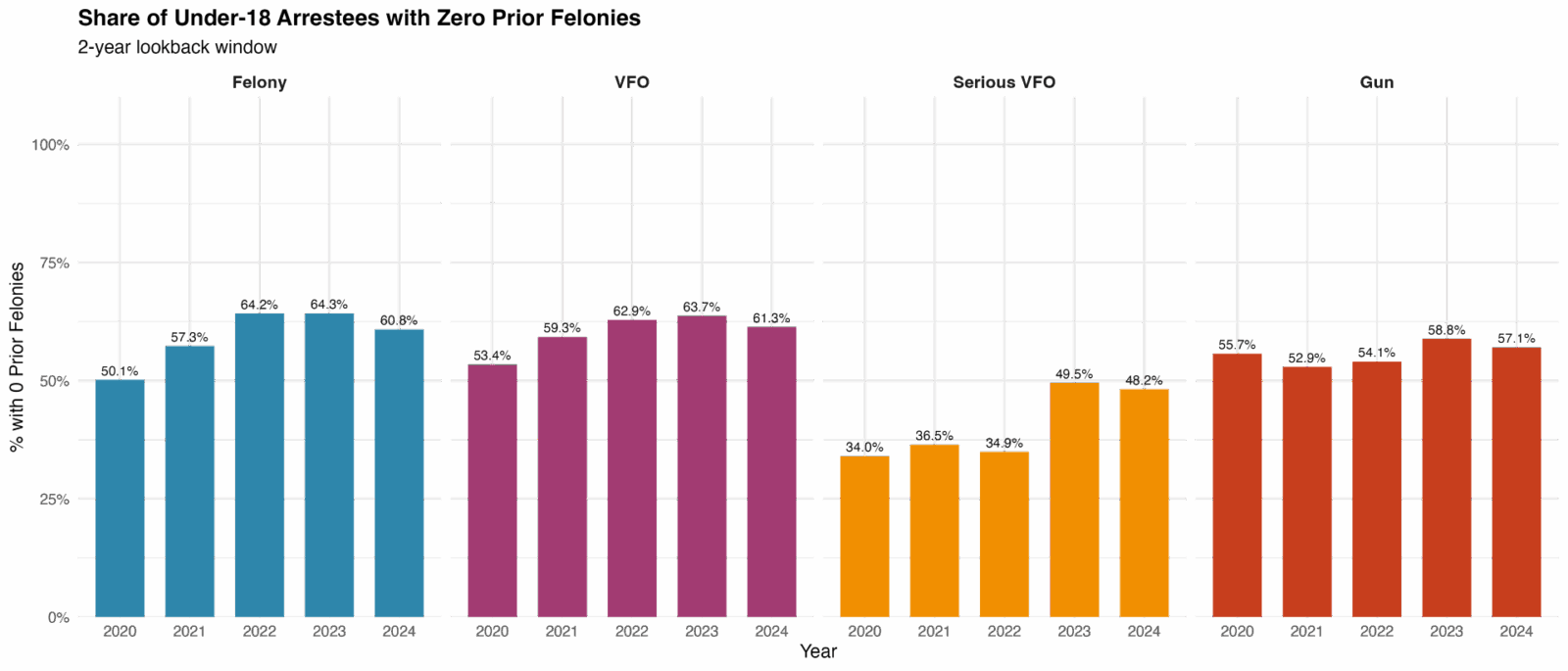
Count and Share of People Under 18 Arrested with No Prior Felony Arrests
The share of young people arrested with no prior felony arrests has shifted higher in some categories in recent years.
MOCJ’s NYC in Context series brings policy and operational questions into sharper focus by using data to contextualize an issue from multiple angles. Stories evolve over time and may be updated as new trends and insights emerge.