Mayor’s Office of Special Enforcement
New York City Council Committee on Housing and Buildings
Christian Klossner, Executive Director of the Mayor’s Office of Special Enforcement
November 20, 2025
Chairperson Sanchez and committee members, thank you for the opportunity to discuss Intros 948-a and 1107-a. My name is Christian Klossner, and I am the Executive Director of the Mayor’s Office of Special Enforcement (OSE), which is overseen by the Mayor’s Office of Criminal Justice.
While the bills’ stated intent is to be about one- and two-family homes, both bills impact every unit of housing in the city and threaten to fundamentally alter New York City’s housing market.
In my testimony, I will focus on four important points:
- How New York City’s existing short-term rental laws currently operate;
- How these bills could negatively impact the local housing market and for the many New Yorkers struggling to find stable housing;
- How the bills will create a more dangerous environment for residents, guests, and first responders; and
- How significant increases in short term rentals will negatively impact quality of life.
First, it is important to be clear about the current laws in New York City.
For decades, the city’s Housing Maintenance Code and Building Code have required the legal use of the city’s housing stock – in both apartment buildings and one- and two-family homes – to be for permanent occupancy by a family.1 The term “family” allows not more than two “boarders, roomers, or lodgers” to rent part of the unit so long as the permanent occupant is occupying the unit and maintaining a common household with the lodgers. According to the legislative history, the limit of two boarders was proposed in 1967 to prevent excessive occupancy that would lead to “inadequate facilities” and “neighborhood deterioration.”
When online booking services arrived, the short-term rental market significantly
increased, taking thousands of long-term rental units off the housing market and, according to numerous studies, driving up the cost of rent.
To combat this significant increase in illegal activity and its impacts, City Council adopted the Short-Term Rental Registration law, also known as Local Law 18 of 2022.
But let me be very clear: For far longer than these online companies have existed, it has been illegal to rent out your entire unit for less than 30 days, or to rent part of your home to more than two guests, no matter how many units were in your building.
Local Law 18 didn’t change the laws I just described, it simply required hosts to follow them. It did not ban short-term rentals. Instead, it made enforcement of existing protections far more efficient. It requires hosts to register, and it requires platforms to verify the registration status. Local Law 18 allows the city to actually prevent illegal activity from depleting our housing stock, it prevents the additional upward pressure on rents associated with short-term rentals, and it provides hosts the chance to know their rental is legal before putting it on the market. Now, Intros 948-A and 1107-A risk undoing the significant gains made under Local Law 18.
Let me start with a discussion of the impacts these bills would have on our housing stock. While both bills suggest they apply only to one- and two-family homes, each changes the definition of “family” in city laws. Changing the definition of “family” would apply to every home in the city, not just one- and two-family homes. For instance, 948-A would allow every tenant in the city to host four adult guests and an unlimited number of people under 18 in their apartment.
948-A also redefines one- and two- family homes from “exclusively” for permanent use to “primarily” for permanent use, and 1107-a contains the same provision although just for two family homes. While that may seem like an insignificant change, it is not. During litigation over Local Law 18, it was argued that one- and two-family homes should be allowed to have unhosted rentals for 182 days a year, relying on the phrase “as a rule” in the relevant Building Code occupancy classification. The city responded that the Building Code definitions of one- and two-family dwellings required they be used “exclusively” as permanent housing. The litigation against the city was dismissed, but now, through these bills, the City Council is being asked to legislate this interpretation and open the floodgates to unhosted short-term rentals.
Here is what could happen with those floodgates open.
One- and two-family homes make up over 28% of the city’s housing stock and just over 14%, or 320,000 units, of our rental stock. This bill allows for the potential loss of this entire group of homes to the short-term rental market, which would be devastating, especially in the context of an ongoing housing crisis, and in a moment when the 2023 New York City Housing and Vacancy Survey (NYCHVS) showed our net rental vacancy rate is just 1.41% and under 1% for the lowest-cost homes.
While difficult to quantify, the bill also has the potential to drive up purchase costs, making it even harder for families to afford their first home. Those who buy and take out a mortgage based on the short-term rental income may be severely overextended the next time New York sees a tourism slowdown or an international pandemic.
Ultimately, if these bills increase speculation and reduce inventory, they will also increase market rate rents.
948-A in particular would also incentivize investors to shop for properties as large as possible to accommodate four adult boarders and an unlimited number of children in order to maximize revenue. But that will squeeze large New York City families, especially multi-generational families, who will have to compete for the same inventory in an already-tight housing market.
We hope the Council will also consider that tenants generally have fewer rights in one- and two-family homes when compared to other parts of our housing stock. This legislation will incentivize displacement of current tenants to use the units for tourist rentals instead of homes.
Not only do these bills pose severe threats to the housing market, they create conflict with critical safety requirements. For example, allowing four boarders and an unlimited number of children will likely conflict with provisions of the Housing Maintenance Code related to how much light, ventilation, and space each occupant is required to have. It would also incentivize cramming large parties into small spaces or illegally converted basements, cellars, and attics. And according to the New York City Fire Department and the Department of Buildings, these bills pose unacceptable safety risks and do not make sense from a life safety point of view.
One- and two-family homes – which are also referred to as private dwellings – are exempt from many of the safety precautions required for the kind of activity these bills would allow. They don’t have sprinklers or fire alarms that automatically summon the Fire Department. They aren’t required to be built with the same level of flame-resistant materials. They are among the city’s most combustible buildings, and amongst the most dangerous buildings in which the Fire Department conducts search, rescue, and fire-fighting operations. In fact, over the past few years, approximately a quarter of all structural fires have occurred in private dwellings, and fires in private dwellings have accounted for disproportionately greater percentages of serious fires and deaths from fires.
The bills compound these existing dangers by: 1) allowing commercial level use, 2) dramatically increasing the occupant load – effectively allowing conversion of private dwellings into multiple dwellings – including allowing an unlimited number of children who are some of the most vulnerable and likely to require assistance when escaping a burning building, 3) eliminating the required presence of a permanent occupant who knows the layout and locations of exits, and 4) allowing a significant expansion of locked interior doors that pose safety risks for occupants and firefighters alike. In a fire situation, when seconds matter, any barrier that slows firefighters conducting search and rescue operations or that prevents a quick exit could cost lives.
Finally, I will turn to concerns about the impact on neighborhoods.
OSE has received over two thousand complaints both this year and last, and almost three thousand in 2023. Complaints from neighbors of short-term rentals express concern over quality-of-life impacts such as excessive noise, late night parties on weekdays, trash piling up, and tourists ringing the wrong doorbell in the middle of the night. Some tenants allege that the illegal activity is done to harass them into giving up their lease. And more and more short-term rental guests are reporting concerns about consumer deception, unsanitary conditions, and a concern that their stays were illegal. It stands to reason that a sharp increase in short term rentals where the host is not present will turn into a sharp increase in the impacts that lead to these complaints.
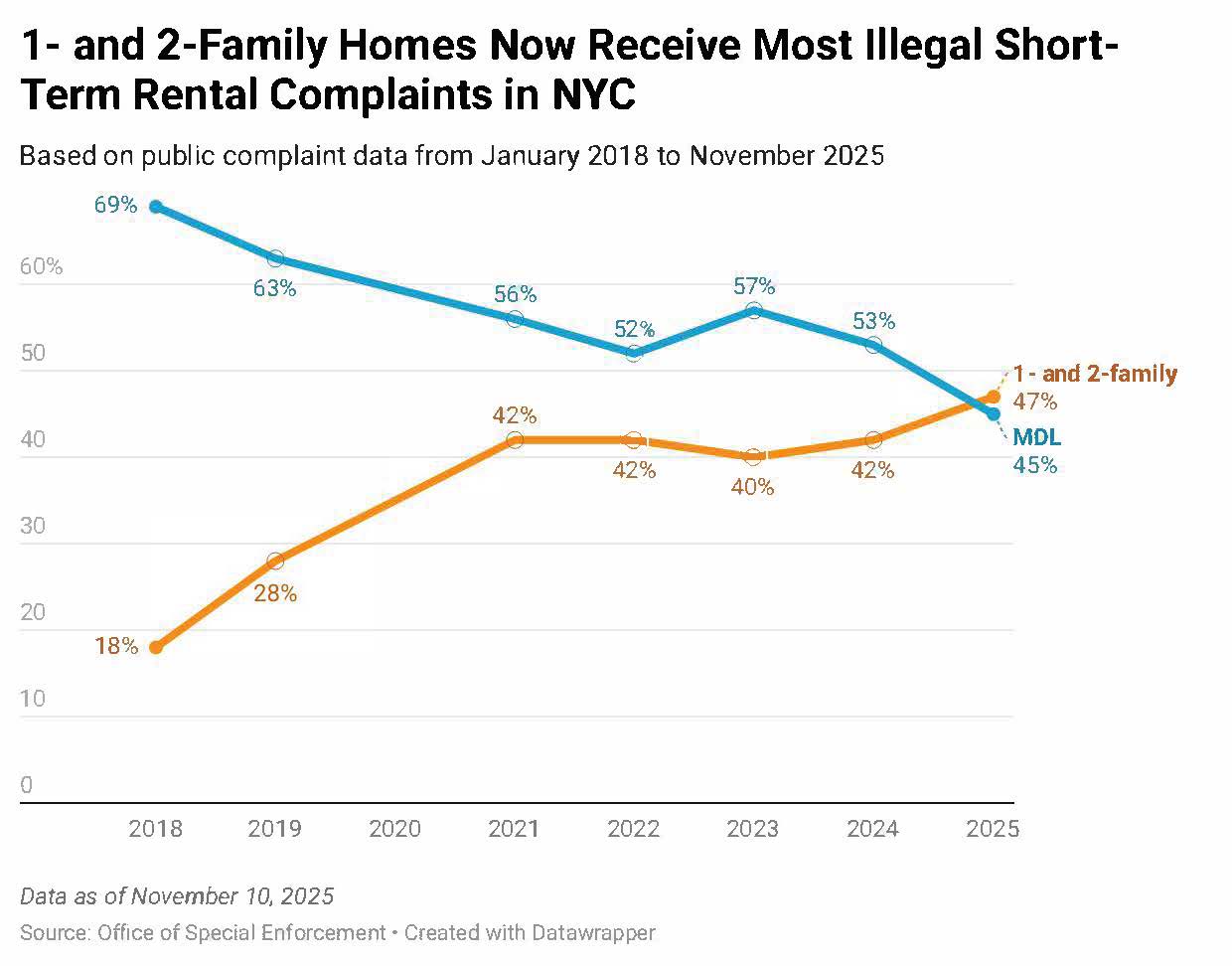
I have attached to my testimony a chart that shows the percentage of the complaints each year, broken down by building type. In 2018, the vast majority of complaints were from multiple dwelling units. Since then, complaints about one-and two-family homes have made up an increasing percentage of complaints, and as of earlier this month, 2025 will be the first year in which there are more complaints about activities in one- and two-family homes than in multiple dwellings. These are people who have asked the City for help, and OSE asks this committee to consider these complaints as though the people filing them were here today to testify.
For all of these reasons, the administration opposes these bills, and I ask the Council to seriously consider their harmful unintended consequences.
Thank you again for the chance to testify, and I look forward to your questions.